

Communicating with people who have Alzheimer’s disease is sometimes difficult. However, the effectiveness will depend on the stage of the disease. In any case, the ability to communicate begins to decline gradually, even in the early stages. This condition causes one of the most difficult, frustrating, and distressing problems faced by patients, their families, and professionals alike.
People with Alzheimer’s find it increasingly difficult to express themselves clearly and/or understand what others are saying, and the same is true for carers, family members, and professionals. Therefore, learning to communicate with these individuals is just as important as learning to understand them.
Changes in Communication in People With Alzheimer’s and Other Dementias
- People with Alzheimer’s or other dementias often have difficulty finding a word and solve the problem by replacing it with another, even if it makes no sense.
- They cannot understand what is said to them, or they only understand part of it.
- They can speak fluently or smoothly, but what they say often makes no sense.
- They will tend to show a decline in their ability to write and understand what is written.
- They will tend to lose track of the conversation. They are able to talk about the distant past, but not about recent events.
- They may lose sight of social norms and conventions, interrupt conversations, ignore the person speaking, or simply not respond when spoken to or addressed.
- They may have difficulty expressing their emotions adequately, going from laughter to tears, from tears to anger, or vice versa.
- They may babble, but it’s impossible to understand what they’re trying to say.
- They use coded, critical, or nebulous language, with subordinated words and phrases that are very difficult to understand or decipher.
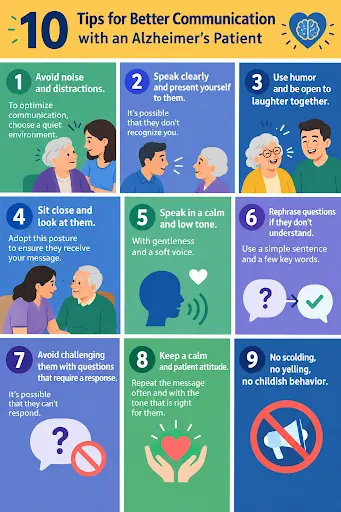
10 Tips for Improving Communication With a Person With Alzheimer’s
1. Be Flexible
what works today may not work tomorrow. Each person is unique, and what works for one person may not work for another. You have to try different approaches and see what works best for each individual with Alzheimer’s.
2. Preserve Their Self-Esteem
Respect and self-esteem should never be forgotten. Do not scold or hurt the person emotionally as if they were a child; they are not. Maintain adult-to-adult communication. Continue sharing activities (while possible), motivating the person and letting them know how important they are. Do not argue with the person in front of others, as they will also be aware of the situation.
3. Speak Calmly and Clearly
The way you speak to people with Alzheimer’s and other dementias is critical. Try to be calm, kind, and courteous. Speak in short, simple sentences, focusing on a single idea. Talk about specific events they might remember. Encourage them with positive words and include information in the conversation that will help them reorient themselves, for example, about people they no longer recognise, such as saying, “This is your daughter, Sonia.”
4. Create a Suitable Environment
The environment should be as pleasant as possible, avoiding loud noises or activities that might be disruptive, such as playing the television too loudly. Make sure that the things they need are in their place (for example, glasses, hearing aids, or dentures). Try not to move while speaking to them. Maintain the same routines (whenever possible) to minimise confusion. Sit close to the person when speaking to them, never in a position higher than them, and maintain eye contact. If the person with Alzheimer’s is in a group, don’t leave them at the back where they feel uncomfortable.
5. Simplify Activities
Simplify everyday tasks, improve simple things they can understand, and avoid the frustration of not being able to do anything. For example, break down clothing when dressing them; instead of saying “this is your clothing,” it’s much better to say “this is your skirt,” and when they’re finished, say “these are your shoes.”
6. Help Them Find the Words
Positively encourage them to find the word to name objects by simply asking, “What is this?”
7. Stay Calm During Anger or Abuse
It’s important to avoid getting angry or engaging in pointless arguments that the other person won’t understand. Don’t discuss the person’s false ideas or hallucinations, as this only confuses them and frustrates the person trying to help.
8. Encourage Laughter
Nothing beats laughter and humour, so encourage it. They’re a fantastic way to release misunderstandings. Laughter is one of the best remedies.
9. Use Body Language
Pointing or indicating can greatly aid communication. Gently touch him with your hands or make soft gestures that convey affection and let him know you care. Do not use force or struggle.
10. Ask Questions
Avoid asking too many questions, emphasise those that have a yes or no answer, and give them enough time to respond. Be patient.
Other Forms of Communication: Other forms of communication: devise other ways to communicate using gestures, photos, objects, etc. Things that bring back pleasant memories, such as music.
Never Give Up: Always blame the disease, not the sick person.
Conclusion
Alzheimer’s, like many dementias, affects communication, and these tips can help family members and carers better understand the situation the person with Alzheimer’s is going through and what needs we can help them meet. We’d love to hear your thoughts and any experiences that might enrich this post.
Also Read: Crohn’s Disease: Causes, Treatments, And Prevention




One comment on “10 Tips to Improve Communication With a Person With Alzheimer’s”